Ramadan: Fasting as a Path to Health and Renewal

Congratulations on the Arrival of the Blessed Month of Ramadan

We congratulate the Muslim community on the arrival of the blessed month of Ramadan—a sacred time dedicated to reflection, self-discipline, and renewal.

At its core, Islam calls humanity toward health and balance. Fasting in Ramadan is a powerful process of restoring and strengthening well-being.

From a physiological perspective, fasting encourages the body to shift into fat-burning mode. One important consideration during this process is how we break the fast. When the body has been fasting for many hours, it becomes more sensitive to sudden spikes in blood sugar. A rapid rise in blood sugar—especially immediately at iftar—can place unnecessary stress on the body.

A simple and effective way to reduce blood-sugar spikes at iftar is changing the order in which foods are eaten, without eliminating any foods entirely. For example, a common iftar meal may include rice and stew, salad or yogurt, and sweet foods such as dates or traditional desserts.

A typical eating order often looks like this:

  1. Dates, sweets, tea

  2. Rice and stew

  3. Salad or yogurt

This sequence tends to cause the highest blood-sugar spike.

A healthier order—while keeping the same foods—would be:

  1. Salad or yogurt (fiber-rich foods; vinegar-based salads can be especially helpful)

  2. Rice and stew

  3. Dates or sweets

This approach significantly reduces blood-sugar fluctuations and supports metabolic health. Immediately after fasting, the body’s insulin response can be temporarily reduced. However, after a short recovery period, individuals who fast often demonstrate improved insulin sensitivity and overall metabolic health compared to before fasting.

This highlights an important principle: right after breaking the fast, the body is more vulnerable to damage from high-sugar foods, which is why beginning iftar gently—with fiber-rich foods and mindful sequencing—is beneficial.

Ramadan is a month meant to restore health, not strain it. When fasting is combined with awareness and intention, it becomes a means of renewal—physically, mentally, and spiritually.

To explore the scientifically backed health benefits of fasting in more depth, we invite you to watch our video:

Throughout this blessed month, our community will be hosting multiple iftar gatherings, creating opportunities to break the fast together, learn, reflect, and strengthen our bonds. We warmly invite everyone to join us and be part of these gatherings as we share this special time in health, gratitude, and community.

May this Ramadan be a source of healing, growth, and peace for all.
15th of Shaʿbān

Islam emphasizes returning to a healthy spiritual state and mindful living. To 15h of Shaʿbān, our community came together for prayer, Quran recitation, and reflection, renewing our commitment to spiritual and emotional well-being.

Beginning of Shaʿbān

The month of Shaʿbān invites preparation and renewal. Islam encourages proactive care of the body, mind, and soul, and this month serves as a bridge toward Ramaḍān. During Shaʿbān, Muslims are encouraged to strengthen healthy habits through prayer, reflection, and community connection.


Eid al-Mabʿath

Eid al-Mabʿath marks the beginning of the Prophet Muhammad’s (ﷺ) mission and the start of divine guidance for humanity. Islam calls people toward health—health of the body, mind, community, and all aspects of one’s life. On this blessed occasion, our community gathered for reflection and learning, reminding ourselves that true guidance leads to personal and collective well-being.


Happy New Year

Happy New Year

A new year is a fresh beginning—a chance to reset, reflect, and move forward with intention.

At its heart, Islam is an invitation to enter health. To enter Islam is to enter a path of health: caring for the body, calming the mind, and nurturing the soul.

As this year begins, may we choose habits that heal, thoughts that uplift, and actions that bring us closer to well-being in every sense.

Wishing you a happy, healthy, and peaceful New Year

Rajab and the Journey Toward Holistic Health

Rajab, the seventh month of the Islamic calendar, is among the four sacred months honored in Islam, as referenced in the Qur’an (Qur’an, Surah At-Tawbah 9:36). It is a time when mindfulness of our actions, intentions, and inner state carries special weight.

For Muslims, Rajab offers a natural pause—a chance to reset and develop habits that support well-being in every dimension: physical, mental, and spiritual. This may include caring for the body through regular movement and nourishing food, observing fasting, strengthening bonds with family and friends, and reflecting on the many blessings in our lives.

Spiritual practices take on added depth during this month. Prayer and engagement with the Qur’an help nourish the heart and steady the mind, while acts of charity remind us of our responsibility toward others. Whether through volunteering, helping someone in need, or offering simple kindness in daily interactions, even the smallest gestures can carry great meaning.

Let this month be a reminder to strive toward your best self—the healthiest Muslim you can be. Rajab is an ideal time to plant the seeds of health, intention, and growth, and to nurture them until they blossom into lasting change throughout the year ahead.

Commemorating the Birth of Prophet Muhammad (Peace Be Upon Him)

On this blessed occasion of Mawlid al-Nabi, we are deeply grateful to everyone who joined us for the celebration we held in honor of the Prophet Muhammad’s ﷺ birthday. Your presence and spirit made the gathering truly special.

The Prophet’s life continues to be a timeless source of inspiration. Among the many values he exemplified, health—in body, mind, and soul—stood as a core principle. He encouraged mindful living, balanced habits, and compassion as a foundation for true well-being.

As we reflect on his legacy, may we be reminded to live with intention, to care for our health, and to cultivate peace within ourselves and our communities.

Peace and blessings be upon him, and peace be upon you all.

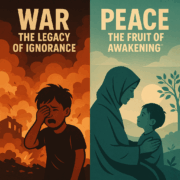
War: The Legacy of Ignorance; Peace: The Fruit of Awakening

In a world where children are killed in the name of faith, we — as humans, as Muslims, and as members of a global community — must pause, reflect, and speak the truth, even when it’s bitter.

Sometimes we need to sit in silence, and from within that stillness, hear the cry of a child echoing through the ruins— a child who knows nothing of borders, politics, or religion. All they understand is that their mother no longer wakes up, and that the sound of explosions keeps them from sleeping at night.

We are witnesses to the endless suffering of the people of Gaza — suffering in which defenseless children are the primary victims. Their pain, regardless of nationality, religion, or race, is a wound on the conscience of humanity.

At Muslims of United States IRH, we believe that war is not a product of progress, but the offspring of ignorance — ignorance disguised as faith, and an instinct inherited from the wilderness. We humans, though clothed and seemingly civilized, still carry within us the primal beasts we once were. The difference is that now our weapons are deadlier, and our justifications more complex.

When we fail to control our fear, anger, and greed, they will control us — and war is nothing but the eruption of these emotions on a collective scale.

On one hand, irrational policies and actions by groups like Hamas, exploiting religious beliefs, have led themselves and their vulnerable people down a path of destruction and death. On the other hand, Israeli leaders could have — with a sense of humanity — created safe zones for mothers and children, shielding them from the horrors of war.

Meanwhile, regional policymakers could have offered models of development, health, progress, and peace instead of exporting weapons and hatred. Nations with ancient history and civilization deserve to have their names tied to hope and construction, not to proxy wars and ruin. How far we are from the day when the name “Iran” is associated not with crisis, but with progress.

We, at Muslims of United States IRH, believe that this world is nothing more than a temporary inn. But how beautiful it would be if this truth became universal. If people understood this simple reality, our rivalries would become competitions in goodness, compassion, and joy — not in killing and destruction.

As Muslims, we believe in a religion whose very name means “peace” and “well-being.”
According to reliable Islamic sources, Islam calls us to wellness and righteous action — not to violence and bloodshed.

In the Qur’an, righteous action (ʿamal ṣāliḥ) is not limited to personal worship; it includes every act or thought that brings kindness, benefit, and compassion to others.

The Prophet Muhammad (peace be upon him) said:
“A Muslim is one from whose tongue and hands people are safe.”
And he also said:
“A momin is one whom people trust with their lives and wealth.”

So how can such a religion be used to justify fear, death, and destruction?

Let us not line up behind names and flags, but unite before the suffering of the defenseless — especially children.

Let us honestly admit that what we are witnessing today in Gaza and elsewhere is the fall of our shared humanity.
Yet, there is still time to rise, awaken, and build a better future.

We call upon all people — regardless of where they live or what they believe — to reflect, to show empathy, and to help rebuild a world where love crosses borders and peace is no longer a dream, but a reality.

We condemn all forms of violence and extremism — whether from states, groups, or in the name of religion or ideology.
And with a quiet yet resolute voice, we declare:
True Islam calls us to humanity, to security, and to building a better world.

Let us seek faith not in weapons, but in open hands, awakened hearts, and righteous deeds.
And if there is to be any competition among nations and peoples, let it be in beautifying this temporary residence we call Earth.

Eid al-Adha

At a time when human sacrifice to idols and deities was widespread, Allah instructed Abraham to perform a symbolic act: he was commanded to enact the sacrifice of his son. But then, Allah sent a ram and told Abraham to inform the people that from now on, instead of killing humans, they may offer a sheep to Allah. In this way, the sin of taking a life would be avoided, and the poor would be fed.

Let it be known: the purpose of sacrifice is not to shed blood to please Allah, but to care for those in need. A sacrifice is only accepted by Allah when the poor are nourished — not when an animal is killed and buried without purpose.

Eid al-Adha Mubarak to all!
We joyfully celebrated this occasion with our community, honoring its true spirit through giving and togetherness.

Eid al-Fitr: A Celebration of Returning to Health

Eid al-Fitr is one of the greatest celebrations for Muslims, marking the end of Ramadan.
According to the Qur’an, all human beings are born with a divine and healthy spirit, referred to as “Fitrah.” However, as time passes, their environment may distance them from this divine state of health.
Eid al-Fitr means “the celebration of returning to Fitrah,” a time to embrace spiritual and physical well-being.
We ask Allah, the Almighty, to grant peace, health, the acceptance of prayers, and blessings in all aspects of this world and the Hereafter for all people and truth-seekers.
Muslims of United States IRH held a special Eid al-Fitr celebration, along with communal prayers, to honor this blessed occasion. May Allah accept our worship and prayers.