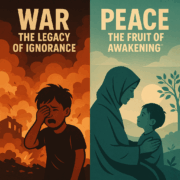
War: The Legacy of Ignorance; Peace: The Fruit of Awakening

In a world where children are killed in the name of faith, we — as humans, as Muslims, and as members of a global community — must pause, reflect, and speak the truth, even when it’s bitter.

Sometimes we need to sit in silence, and from within that stillness, hear the cry of a child echoing through the ruins— a child who knows nothing of borders, politics, or religion. All they understand is that their mother no longer wakes up, and that the sound of explosions keeps them from sleeping at night.

We are witnesses to the endless suffering of the people of Gaza — suffering in which defenseless children are the primary victims. Their pain, regardless of nationality, religion, or race, is a wound on the conscience of humanity.

At Muslims of United States IRH, we believe that war is not a product of progress, but the offspring of ignorance — ignorance disguised as faith, and an instinct inherited from the wilderness. We humans, though clothed and seemingly civilized, still carry within us the primal beasts we once were. The difference is that now our weapons are deadlier, and our justifications more complex.

When we fail to control our fear, anger, and greed, they will control us — and war is nothing but the eruption of these emotions on a collective scale.

On one hand, irrational policies and actions by groups like Hamas, exploiting religious beliefs, have led themselves and their vulnerable people down a path of destruction and death. On the other hand, Israeli leaders could have — with a sense of humanity — created safe zones for mothers and children, shielding them from the horrors of war.

Meanwhile, regional policymakers could have offered models of development, health, progress, and peace instead of exporting weapons and hatred. Nations with ancient history and civilization deserve to have their names tied to hope and construction, not to proxy wars and ruin. How far we are from the day when the name “Iran” is associated not with crisis, but with progress.

We, at Muslims of United States IRH, believe that this world is nothing more than a temporary inn. But how beautiful it would be if this truth became universal. If people understood this simple reality, our rivalries would become competitions in goodness, compassion, and joy — not in killing and destruction.

As Muslims, we believe in a religion whose very name means “peace” and “well-being.”
According to reliable Islamic sources, Islam calls us to wellness and righteous action — not to violence and bloodshed.

In the Qur’an, righteous action (ʿamal ṣāliḥ) is not limited to personal worship; it includes every act or thought that brings kindness, benefit, and compassion to others.

The Prophet Muhammad (peace be upon him) said:
“A Muslim is one from whose tongue and hands people are safe.”
And he also said:
“A momin is one whom people trust with their lives and wealth.”

So how can such a religion be used to justify fear, death, and destruction?

Let us not line up behind names and flags, but unite before the suffering of the defenseless — especially children.

Let us honestly admit that what we are witnessing today in Gaza and elsewhere is the fall of our shared humanity.
Yet, there is still time to rise, awaken, and build a better future.

We call upon all people — regardless of where they live or what they believe — to reflect, to show empathy, and to help rebuild a world where love crosses borders and peace is no longer a dream, but a reality.

We condemn all forms of violence and extremism — whether from states, groups, or in the name of religion or ideology.
And with a quiet yet resolute voice, we declare:
True Islam calls us to humanity, to security, and to building a better world.

Let us seek faith not in weapons, but in open hands, awakened hearts, and righteous deeds.
And if there is to be any competition among nations and peoples, let it be in beautifying this temporary residence we call Earth.

Islam: Captive in the Obvious, by Mohammad Babaee

 When Words Imprison Thought

Sometimes, the greatest prisons we live in have no walls…

No bars, no locks—

only a few words.

Words that entered our minds so early,

so quietly, so unquestioned,

that we no longer notice them…

and yet, we see the entire world through them.

Many of our intellectual dead ends do not come from ignorance,

but from knowing too much of what we have never dared to question again.

Assumptions planted in childhood—

before we could choose,

before we could examine—

took root within us,

and over time, silently,

became our definition of truth.

The human mind understands the world through touch.

Through sight, impact, resistance.

To us, something is “real” if it stands firm against our hand.

If it can be pointed at and named: this is it.

And this simple habit

has seeped into the deepest layers of our thinking.

Even when we speak of a “particle,”

we imagine something like a tiny solid stone.

But reality is not obliged to fit our imagination.

It is not necessarily solid, nor is it something that can be pointed to,

not even a “thing” in the way we are used to.

And when this hidden error

carries over from science into religion—

it is no longer just a misunderstanding…

it becomes destiny.

Where one translation changed the course of a civilization

From our earliest years,

we were told:

“Islam means submission.”

And we accepted it—

without pause.

But what did “submission” come to mean for us?

Silencing questions.

Setting aside reason.

Surrendering unconditionally.

This definition has been repeated so often

that no one stops to ask:

What if this is not true?

But truth is not created by repetition.

In the language of revelation,

“Islam” is not a label—

it is an invitation.

An invitation into a state:

a state of silm «سِلم» —

wholeness, balance, deep inner peace.

A form of health

that is not limited to the body,

but flows through the mind,

the thought,

the relationships,

and the direction of our lives.

Islam is an answer to a question:

How does a human being remain whole

in a world that constantly pulls them apart?

The Forgotten Secret of Language: When Meaning Changes Direction

In Arabic, words are not merely formed—

they are directed.

Roots are raw material,

but patterns shape their movement,

like a current guiding a boat.

And if you miss that direction,

you may understand the word—

but lose its meaning.

Consider the root S–L–M «س-ل-م».

From these three letters,

two entirely different paths emerge:

Islam-«اسلام»: a conscious movement, an active step toward health

Taslim- «تسلیم»,(submission): a relinquishing, a handing over of oneself, hoping to reach health

These are not the same.

They are not even aligned.

One rises from within;

the other yields to something outside.

One is a choice;

the other is the abandonment of choice.

Islam is the human being

standing on their own feet,

choosing to realign their path.

Submission is sitting down—

and handing that path to another.

And perhaps the greatest turning point in history

happened right here:

When these two were made identical.

When action was translated into passivity.

When understanding was replaced with unquestioned obedience.

Islam: Before It Was a Name

If Islam were merely a name,

how could it exist before itself?

And yet, the Qur’an repeatedly speaks

of people who lived long before the Prophet—

and still calls them “Muslim.”

Abraham,

at a moment when no formal religion exists,

hears:

“Bring Islam.”

And he responds:

“I accepted Islam.”

This is not the adoption of a label.

This is a moment of awakening.

A moment when a human being realizes

how they must live.

Elsewhere, humanity is told:

“He named you Muslim before.”

Meaning: this path is older than all names.

Islam: Something to Be Lived, Not Merely Said

Islam is not a name.

It is not a badge of identity.

It is not membership in a group.

Islam is becoming.

An inner movement

toward balance.

A continuous decision

to return to wholeness.

Not by silencing the mind—

but by illuminating it.

Not through fear—

but through understanding.

And perhaps,

if we dare to ask ourselves once more—

without fear, without inherited answers—

What is Islam?

Then, for the first time,

we may not find the answer in words…

but within ourselves.


By Mohammad Babaee


About Author

Mohammad Babaee has authored a number of books, including the philosophical and scientific book “The Inner World.” Babaee believes that consciousness is the essence of our being, and our perception of the world is not real. Babaee also believes that everyone is born with a religion, and that common religions as we know them are instructions for retaining our health in order to revive our innate religion. Those interested in exploring more of his work are invited to visit his official website, where his publications are thoughtfully showcased: www.babaee-books.com
Eid al-Adha

At a time when human sacrifice to idols and deities was widespread, Allah instructed Abraham to perform a symbolic act: he was commanded to enact the sacrifice of his son. But then, Allah sent a ram and told Abraham to inform the people that from now on, instead of killing humans, they may offer a sheep to Allah. In this way, the sin of taking a life would be avoided, and the poor would be fed.

Let it be known: the purpose of sacrifice is not to shed blood to please Allah, but to care for those in need. A sacrifice is only accepted by Allah when the poor are nourished — not when an animal is killed and buried without purpose.

Eid al-Adha Mubarak to all!
We joyfully celebrated this occasion with our community, honoring its true spirit through giving and togetherness.

Eid al-Fitr: A Celebration of Returning to Health

Eid al-Fitr is one of the greatest celebrations for Muslims, marking the end of Ramadan.
According to the Qur’an, all human beings are born with a divine and healthy spirit, referred to as “Fitrah.” However, as time passes, their environment may distance them from this divine state of health.
Eid al-Fitr means “the celebration of returning to Fitrah,” a time to embrace spiritual and physical well-being.
We ask Allah, the Almighty, to grant peace, health, the acceptance of prayers, and blessings in all aspects of this world and the Hereafter for all people and truth-seekers.
Muslims of United States IRH held a special Eid al-Fitr celebration, along with communal prayers, to honor this blessed occasion. May Allah accept our worship and prayers.


Laylat al-Qadr: A Night of Blessings and Healing

Laylat al-Qadr is one of the holiest nights in the Islamic calendar. It is the night when the Quran was first revealed to the Prophet Muhammad (peace be upon him), making it a time of immense spiritual significance. The Quran describes this night as being “better than a thousand months” (Surah Al-Qadr 97:3), meaning that acts of worship performed on this night carry rewards far beyond those of any ordinary day or night. It is a night in which health and well-being are granted to all beings. To honor this blessed occasion, the Muslims US IRH Association held prayers and a gathering. The night was filled with Quranic recitations, heartfelt duas, and moments of reflection, allowing the community to come together in worship and seek the blessings of this sacred night.
May Allah accept our prayers and grant healing and health to all.


Ramadan Mubarak: A Time for Reflection, Community, and Spiritual Growth

As the blessed month of Ramadan approaches, we at the Muslims US IRH Association extend our warmest greetings to you and your loved ones. Ramadan is a sacred time of reflection, prayer, fasting, and strengthening our bonds with Allah and one another. It is an opportunity to achieve the highest levels of health in all areas of our lives. 

This year, the Muslims US IRH Association is excited to announce a variety of events to enhance your Ramadan experience, both spiritually and socially. These events will be held both online and in person, ensuring opportunities for everyone to participate and connect. Our programs will include online Quran recitation sessions to deepen your understanding of the Quran, in-person community Iftars to break the fast together, and collective Dua and reflection circles to focus on spiritual growth. To stay informed about all our events join our email list. By signing up, you’ll ensure you never miss an opportunity to engage in our Ramadan programs and strengthen your connection with the community.

May this Ramadan bring blessings, peace, and joy to you and your families. Ramadan Mubarak!


Celebrating the 15th of Sha’ban: A Joyous Occasion for All

Happy 15th of Sha’ban!

We congratulate the Muslim community on this blessed occasion, marking the birth anniversary of Imam Mahdi (عج). This special day reminds us of hope, justice, and the promise of a brighter future.

To honor this momentous occasion, our community came together to hold a meaningful event filled with prayer, reflection, and joyous celebration. The program included inspiring talks, recitations, and a warm gathering to celebrate this important milestone in the Islamic calendar. It was a wonderful opportunity to unite in faith and gratitude.

May the 15th of Sha’ban bring blessings, peace, and harmony to everyone. Let us continue to embody the values of compassion and justice that this day inspires. Stay tuned for updates on future events as we strengthen our bond as a community.

The Month of Sha’ban: A Sacred Opportunity for Growth

At last, the blessed month of Sha’ban is upon us—one of the sacred months in Islam, offering us yet another opportunity to strive to be our best selves. But what does that truly entail?

Islam is a religion that values holistic health, encouraging its followers to attain the highest levels of physical, mental, and spiritual well-being. Sha’ban presents a unique chance for us to nurture health in all areas of our lives.

Dua and reciting the Quran are essential for fostering the health of the mind and soul. In this spirit, the Muslims US IRH Association will be holding online sessions throughout this month, featuring both dua and Quran recitation.

By joining our email list, you’ll receive invitations to participate in these enriching activities, designed to promote both personal growth and collective community strength. Let us use this sacred month to seek Allah’s blessings, deepen our faith, and support one another in our journey toward a more fulfilling life.

Eid al-Mab’ath

We warmly celebrate the blessed occasion of Eid al-Mab’ath. This sacred day marks the anniversary of the Prophet Muhammad’s (peace and blessings be upon him) divine mission to guide humanity with the message of health, guiding humanity to embark on a journey of gaining health in all aspects of life.

A celebration will be held on this occasion, in order to reflect on the values of kindness and wisdom that the Prophet (PBUH) taught, and to strive to achieve health in all aspects of our daily lives.

A Message of Support for Those Affected by the Southern California Fires

In the name of Allah, the Most Compassionate, the Most Merciful.

With heavy hearts, we at the Muslims US IRH Association extend our solidarity to all those affected by the devastating fires in Southern California, particularly the Palisades Fire and the Eaton Fire. This tragic event has impacted homes, beautiful natural landscapes, and the peace of many families.

During this difficult time, we stand with the victims of this disaster and pray for Allah to grant patience and strength to everyone facing these hardships. We also pray for the safety and well-being of the brave first responders working tirelessly to contain the fires.

For those seeking reliable information and resources related to the wildfires, we recommend the following:

Cal Fire Incident Information (click here): Real-time updates on active wildfires, including maps and containment progress.
Ready for Wildfire Evacuation Guide (click here): Guidance on evacuation preparedness and safety during wildfire emergencies.

Muslims US IRH Association